Most companies have situations where something happens and the right people need to know immediately.
An IT system goes down. A machine stops. A building reports an alarm. A customer needs urgent assistance.
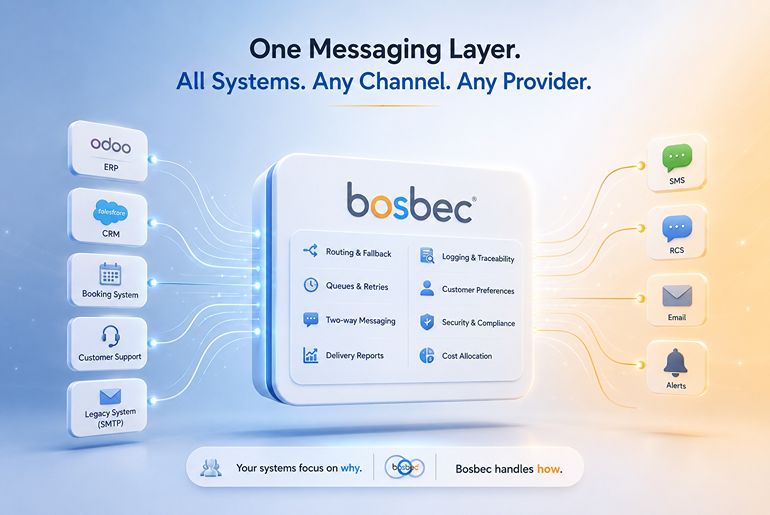
Sending an SMS, RCS message or notification is easy.
The difficult question is: Who should receive it right now?
The right person changes all the time
For an incident or on-call service, a static contact list is rarely enough.
People start and finish shifts. Teams change. Someone is sick. Responsibilities move between groups. An engineer who should receive an alert at 10 AM might be the wrong person at 10 PM.
The information about who is actually available often already exists somewhere.
It might be in a scheduling system. It could be an on-call roster. Or it could simply be the people who are currently logged into a specific group in your phone system.
The challenge is turning that information into something you can use automatically.
Use your phone system as the source
Let’s take a contact center as an example.
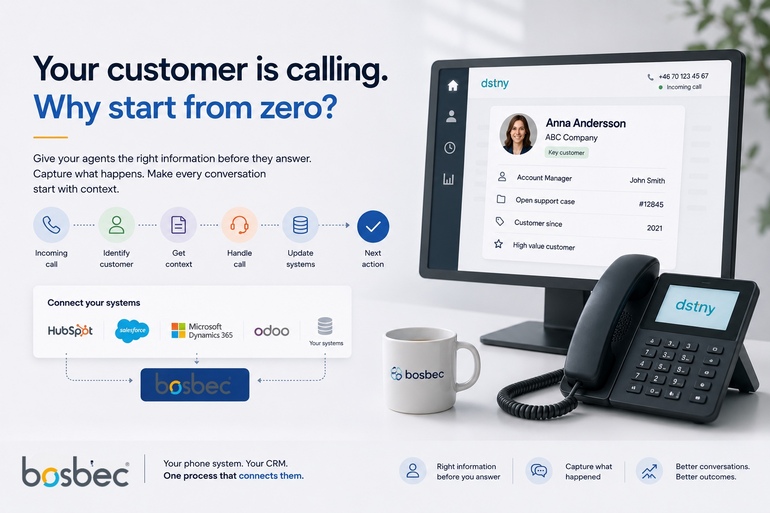
If your employees already log in and out of ACD groups during the day, the phone system already knows something very useful: who is part of each group and potentially available right now?
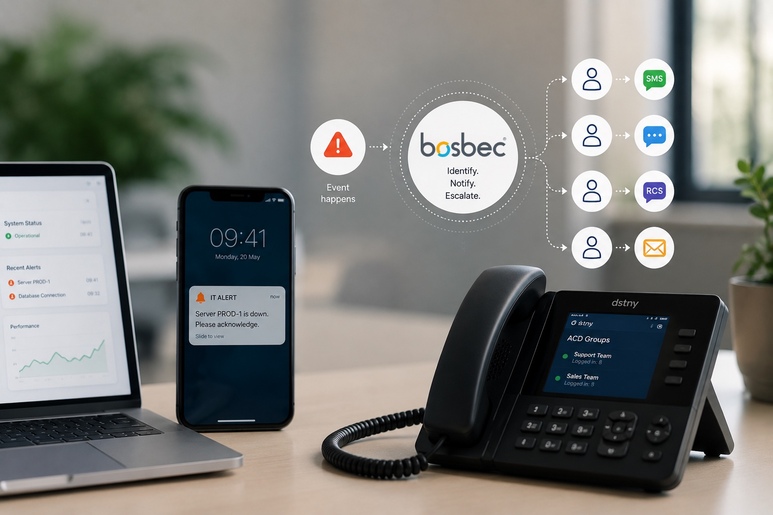
Instead of maintaining the same information in another system, Bosbec can bring the ACD groups and agents from Dstny into your Bosbec account.
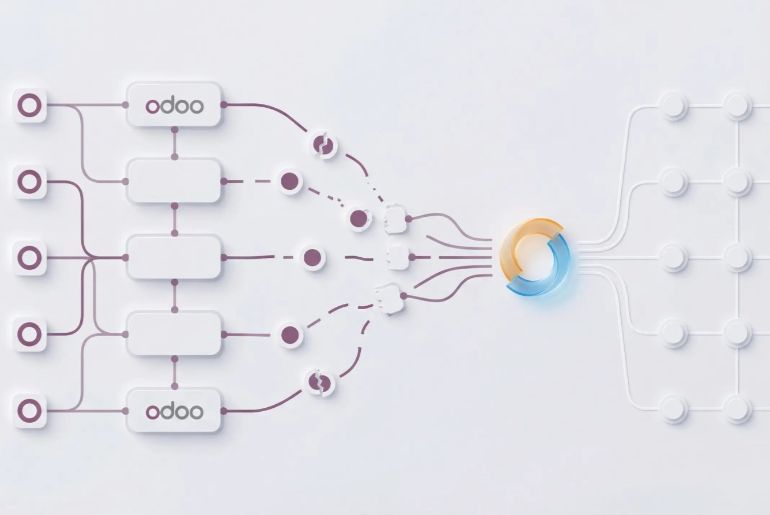
Bosbec’s ready-made Dstny template retrieves the available ACD groups, their agents and mobile numbers and stores them as Units that can then be used by other workflows. The synchronization can also be scheduled so Bosbec stays aligned with the current configuration in Dstny.
Now that information can become part of something bigger.
From an ACD group to an incident service
Imagine an IT alert is received.
Bosbec can use information from the phone system to identify the relevant group and use its members as the starting point for the alert process.
Alert received? Find the responsible group.
Right people identified? Send the alert by SMS or another channel.
Someone acknowledges it? Record who accepted the incident.
No response? Escalate to another person or group.
Need more context? Add information from another system before sending the alert.
And the source doesn’t have to be Dstny
This is the bigger idea.
For another company, the best source for who is working right now might be a scheduling system. For another, it could be an HR system, an on-call application or something completely different.
Bosbec lets you build around the source that makes sense for your business.
That’s important because the difficult part of an incident service isn’t usually the message itself.
Event → Responsibility → Availability → Communication → Acknowledgement → Escalation
And making sure that process keeps working as people and circumstances change.
Why build this in Bosbec?
You could build the whole incident service yourself.
Connect to the phone or scheduling system. Retrieve users and groups. Build the logic. Connect an SMS provider. Handle responses. Add escalation. Build logging and queues. Run it and maintain it.
But once again, a seemingly simple requirement has become a software project.
With Bosbec, you can start much further ahead.
For Dstny, for example, there is already a template for importing ACD groups and agents into Bosbec.
Start with that. Then add the alert. Add your rules. Add SMS, RCS or another channel. Add acknowledgement and escalation. Connect another data source if you need it.
The template solves the starting point. You build the process your business needs.
Start with what your systems already know
Companies already have enormous amounts of useful operational information hidden inside the systems they use every day.
Just as we showed in “Your customer data already knows what you should do next”, the opportunity is often not to create more data. It’s to make the data you already have useful in another process.
For an incident service, the phone system might already know something extremely valuable: who should we contact right now?
Bosbec lets you take that information and build the rest around it.
Start with a template. Connect the information you already have. Build the incident service you need.
https://help.bosbec.com/knowledge-base/send-sms-to-logged-in-agents-in-a-dstny-acd-group/