What if your voicebot could do more than answer the phone?
We’ve all experienced it. You call a company, navigate a phone menu, wait in a queue, explain your problem, and eventually get transferred to someone who asks you to explain everything again.
It’s frustrating for customers. And it’s an expensive way for businesses to handle simple, repetitive requests.
AI voicebots are changing what’s possible. But there’s a big difference between a bot that can have a conversation and one that can actually solve a problem.
The real opportunity isn’t just answering more calls.
It’s helping more customers get things done.
A voicebot that can take action
Imagine calling a healthcare provider to book an appointment.
Instead of waiting for a receptionist, you speak to a voicebot. It asks what you need, identifies you, checks the available appointments, and offers you a couple of options.
You choose a time. The bot confirms your booking.
Done.
No queue. No transfer. No need for an employee to manually enter the appointment.
This is the kind of voicebot you can build with Bosbec. Our voicebot template demonstrates the complete process, from answering a call to looking up customer information and updating an appointment.
And booking appointments is just the beginning.
What problems could your voicebot solve?
The interesting part isn’t the technology itself. It’s what happens when you connect a natural conversation to the systems your business already uses.
Here are a few examples.
- Handle appointments without tying up your staff
Let customers book, reschedule, or cancel appointments by phone. Connect the bot to your calendar or booking system so it can work with actual availability.
Think healthcare providers, car workshops, hair salons, service companies, and other appointment-based businesses.
- Give customers answers based on their own information
A customer calls to ask about an order, delivery, invoice, or service request.
Instead of providing a generic answer, the bot can retrieve the relevant information from your CRM, ERP, or other business system.
The customer gets an answer based on their actual situation.
- Take care of repetitive service requests
Reset a service, register a support case, update customer details, or collect information before handing an issue over to an employee.
A voicebot can guide the customer through the process and initiate the next step in your systems.
- Help customers outside office hours
Customers don’t always call between nine and five.
A voicebot can make selected services available around the clock, without requiring your team to be available for every routine request.
- Make conversations useful even when a human needs to take over
Not every issue should be handled by AI.
When a customer needs a person, the bot can collect the relevant information and, if configured for it, pass the context to the right team.
That means less repetition for the customer and a better starting point for the employee.
The secret isn’t just a better AI model
Modern AI can make a voicebot sound remarkably natural.
But a great conversation means very little if the bot can’t access the right information or perform the requested action.
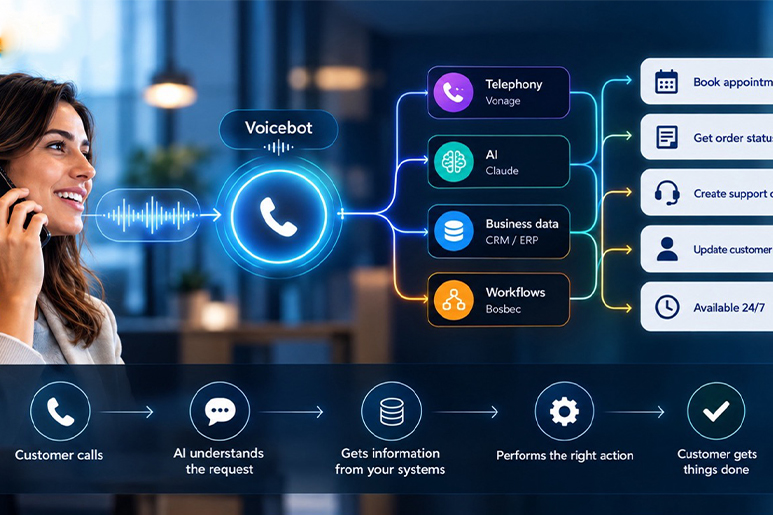
To become genuinely useful, a voicebot needs to connect several things:
- Telephony: Receive calls, listen to the caller, and respond with speech.
- AI: Understand the request and decide what needs to happen next.
- Business data: Retrieve the information needed to handle the request.
- Workflows: Perform actions such as creating a booking, updating a record, or sending a confirmation.
This is where Bosbec comes in.
Bosbec lets you build the workflows that connect the conversation to your business processes. You decide which systems the bot can access, what it can do, and how each action should work.
You’re not limited to a fixed set of predefined voicebot functions.
Build a voicebot that fits your business
Our voicebot template gives you a practical starting point.
It uses Vonage for telephony and speech services, Claude for the AI conversation, and Bosbec to orchestrate the workflow.
In the example, a caller can request an appointment, identify themselves, hear available times, and complete a booking.
You can then adapt the solution to your own needs.
Replace the example customer data with your CRM. Connect your actual booking system. Change the greeting, voice, or language. Add new capabilities by extending the workflow.
Start with a working example and build from there.
The result isn’t just a voicebot. It’s your voicebot.
Stay in control of what you’ve built
There’s another important question businesses should ask before introducing AI into customer-facing processes:
What happens when something goes wrong?
A voicebot needs more than a good prompt. You need to understand how the solution works, what information it uses, and what happens when a connected system doesn’t respond as expected.
With Bosbec, you can inspect and adapt the workflows behind the conversation. Our example also lets you follow execution and review the requests and responses exchanged with the AI model.
That makes it easier to test, troubleshoot, and improve the solution over time.
AI handles the conversation. Your workflows control what happens in your business.
What would you build?
A voicebot for appointments? Customer service? Order status? Internal support? Something completely different?
The possibilities depend on the problems you want to solve and the systems you want to connect.
You don’t have to start from scratch.
Explore our step-by-step guide and get a working voicebot running in your own Bosbec account.
Bosbec — Build what you need. Make it yours.