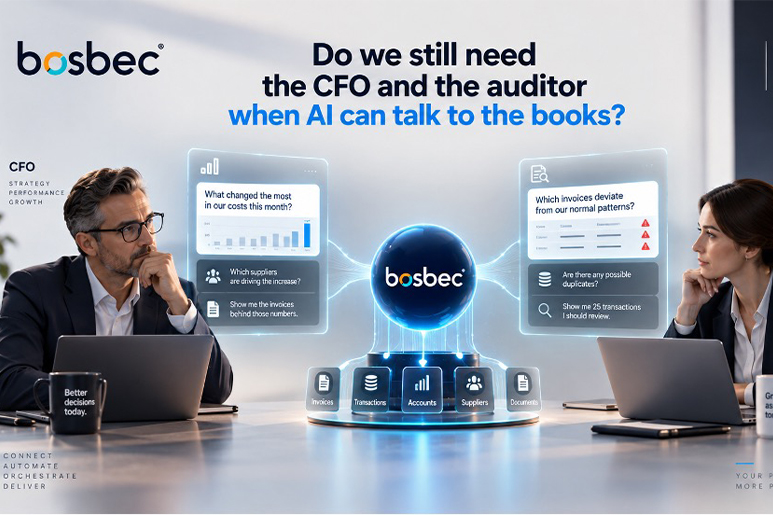
The CFO and the auditor are unlikely to disappear. But their work could change dramatically when AI no longer has to wait for reports, exports and manual samples – and can instead ask questions directly of financial data.
Imagine the CFO starting the morning by asking:
“What changed the most in our costs this month?”
“Which suppliers are driving the increase?”
“Show me the invoices behind those numbers.”
At the same time, the auditor could ask:
“Which invoices deviate from our normal patterns?”
“Are there any possible duplicates?”
“Show me 25 transactions I should review more closely – and why.”
The information is already in the accounting system. The challenge is that getting the answers often requires reports, exports, spreadsheets and manual work.
But what if you could simply talk to the books?
The CFO needs answers – not more reports
Most accounting and ERP systems are very good at storing and structuring financial information. Reporting tools are also good at showing reports that have already been defined.
The problem starts when the next question is not in the report. The CFO sees that a cost has increased and wants to know why. Someone then has to break down the number, compare periods, identify suppliers and perhaps drill all the way down to individual invoices.
With AI, the workflow can instead become a conversation:
“Why did external costs increase in August?”
“Which five suppliers account for the largest increase?”
“Show me the invoices from the two largest.”
The interesting part is not simply that AI can produce a report faster. It is that the CFO can keep asking the next question.
The auditor has a different problem
For the auditor, the challenge is partly the opposite: there is too much information. Thousands of invoices, journal entries and transactions may need to be considered, while it is rarely practical to inspect everything manually at the same level of detail.
AI can help identify what deserves human attention. The auditor could, for example, ask:
“Show supplier invoices above SEK 50,000 that are missing supporting documentation.”
“Has the same invoice number or amount been registered more than once?”
“Which suppliers have unusual account coding compared with their history?”
“Which transactions deviate the most from normal patterns?”
Instead of starting with an unsorted pile of transactions, technology can help point to areas that deserve closer review. That does not mean AI decides whether something is right or wrong. That judgment still belongs to the auditor.
Make the books queryable
For this to work well, it is not enough to upload the entire general ledger to an AI model and hope for the best. The AI needs a structured way to work with the information.
This is where an API becomes useful. In Bosbec, you can build an API that exposes exactly the financial information and functions you want AI to use, for example:
Invoices -> Transactions -> Accounts -> Suppliers -> Customers -> VAT -> Supporting documents -> Periods
The API could expose functions such as:
- getInvoice
- findInvoices
- getTransactions
- getAccountBalance
- getSupplierHistory
- getVATSummary
- findDuplicates
The AI does not need to understand hundreds of thousands of rows on its own. It can interpret the question, use the appropriate functions and then work with the result.
Let the systems calculate – and let AI reason
This is an important principle. If the CFO asks how margins have developed over the last six months, the language model should not be given 100,000 transactions and asked to calculate the answer itself.
Filtering, aggregation and exact calculations can be handled structurally in the backend. AI can instead help understand what the user wants to know, retrieve the right information and explain the result.
The system calculates. AI reasons. People decide.
The same data – very different questions
This may be the most interesting part. The CFO and the auditor can work with the same financial data, but for very different purposes.
The CFO can ask:
- Which costs are increasing the fastest?
- How are our margins developing?
- Which customers contribute the most to profitability?
- How does cash flow compare with the previous period?
- What is behind this change?
The auditor can ask:
- Which transactions deviate from normal patterns?
- Are there possible duplicates?
- Which invoices are missing supporting documentation?
- Which account postings differ from what we normally see?
- Which items deserve closer review?
You do not necessarily need two separate AI solutions. You need a structured way to make financial data available to the questions people actually want to ask.
So, do we still need the CFO and the auditor?
Yes – but their time may be used differently. AI does not have to replace the CFO’s analysis or the auditor’s professional judgment to create substantial value.
If AI can work through large volumes of information, identify patterns, make selections and quickly retrieve the data behind a question, people can focus on the next step:
What does this mean?
Why did it happen?
Is the deviation reasonable?
Do we need to act?
That is where experience, business knowledge and professional judgment remain essential.
Try it yourself – without connecting your accounting system
You do not need to start with a large integration project. In Bosbec, you can build an API and begin with sample data. Create example invoices, suppliers, customers and transactions, expose them through the API, and let AI start asking questions.
Once you have seen how it works, the next step can be to connect your real accounting or ERP system.
Keep the system that is good at accounting. Build what is missing around it.
Bosbec Tutorials show how to build an API and make information available for AI:
Build it yourself – Bosbec Tutorials
Build it. Ask it. See what your numbers can tell you.