When a customer contacts your business, one of the first questions is often surprisingly difficult:
Who are we actually talking to?
For a simple question, the caller’s phone number may be enough to find the right customer record.
But what if they want to discuss an invoice? Change an order? Access personal information? Make a booking? Or perform an action that requires you to know that they really are the person they claim to be?
Different situations require different levels of identification.
And that is where many customer service processes become unnecessarily complicated.
Identification doesn’t always mean the same thing
Sometimes you only need to identify which customer or account the conversation is about.
The caller could enter a customer number, account number, order number, invoice number or organisation number.
Bosbec can use that information to look up the customer in a CRM, ERP, order system or another data source and continue the process.
In other situations, you need to identify the actual person.
Knowing that someone has customer number 12345 doesn’t necessarily prove that they are authorised to access the information connected to that account.
For those situations, stronger identification such as BankID can become part of the process.
Think about a support call
A customer calls support.
Instead of spending the first part of the conversation manually searching for information, the process could start before the agent even answers.
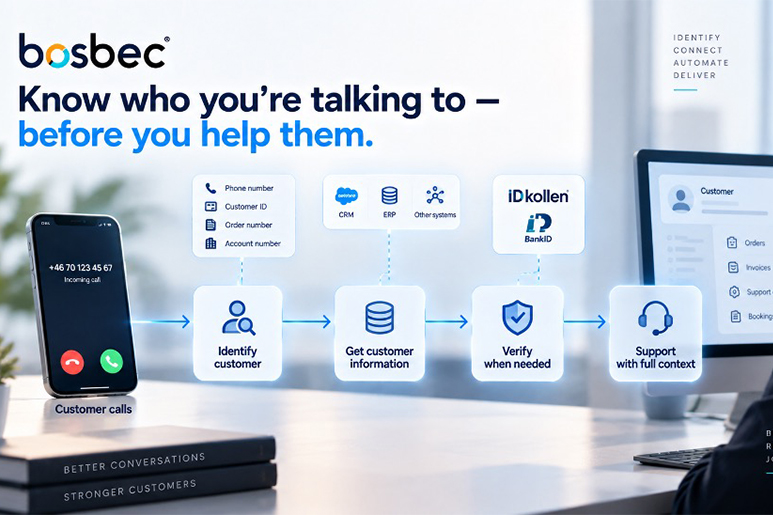
Caller → identify customer → retrieve information → route the call → present the relevant information
The phone number might identify the customer automatically. If that isn’t enough, the caller could enter a customer or account number.
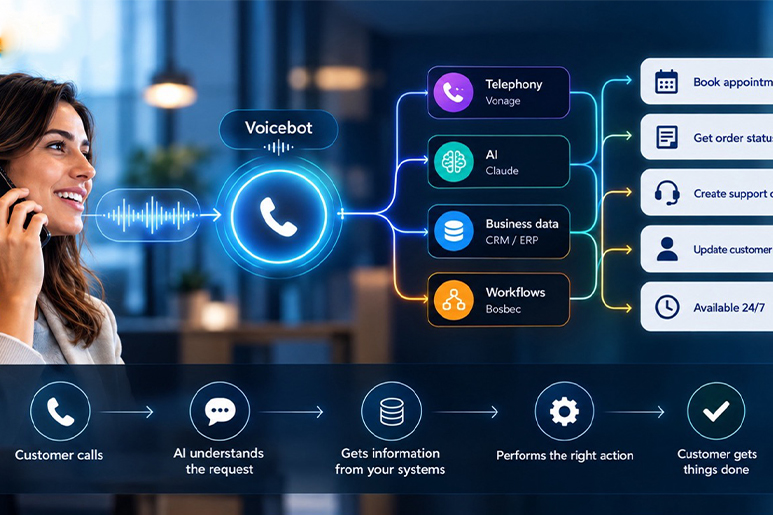
Bosbec can then use that information to retrieve relevant context from a CRM or another business system, so the employee can start the conversation with the right information.
The same idea can solve very different problems
Identification is rarely the final goal. It is usually the first step in another business process.
Billing: Enter an account or invoice number → find the customer → retrieve invoices → answer the question → perhaps send a copy by email.
Orders: Enter an order number → find the order → identify the customer → check delivery status → send updated information.
Support: Identify the customer → find open cases → retrieve product or contract information → route to the right team → log the conversation.
Bookings: Identify the customer → retrieve existing bookings → authenticate if required → reschedule or cancel.
B2B customer service: Enter an account or organisation number → identify the company → retrieve agreements, orders or support status.
The identification method can therefore be adapted to the risk and the action that follows.
Example: Verify the customer with IDkollen and BankID
For processes where you need to verify the actual identity of the person, Bosbec can connect the customer journey to an identity verification service such as IDkollen.
IDkollen provides services for digital identity verification, including BankID, and also provides a REST API that can be used as part of an integrated process.
For example:
Customer calls → customer record is identified → BankID verification is initiated through IDkollen → customer verifies their identity → Bosbec receives the result → the process continues
This makes identity verification one step in the complete customer journey. Once the identity has been confirmed, Bosbec can continue the workflow – for example by retrieving protected information, updating an order, changing customer details or allowing the employee to continue with a sensitive support case.
Learn more about IDkollen: IDkollen website
Bosbec example: Integrating BankID via IDkollen
Build the identification process that fits the situation
You don’t have to choose one identification method for every customer interaction.
A simple enquiry might use:
Phone number → CRM lookup
Another process might use:
Customer number → ERP or CRM lookup
And a sensitive action might require:
Customer number → CRM → BankID verification → perform action
You can also combine methods. A caller’s phone number might identify a likely customer and retrieve the customer record. The conversation can continue normally until the customer asks to perform an action that requires stronger identification. Only then is BankID verification introduced.
That can make the experience both simple for the customer and appropriate for the process.
Don’t build authentication. Build the customer journey.
The real question isn’t:
How do we integrate BankID?
Or:
How do we look up a customer number?
The better question is:
What do we need to know about this customer before we can help them – and what should happen once we know it?
That might require a phone number, customer ID, account number, order number or a verified personal identity.
Bosbec lets you connect those steps with your CRM, ERP, telephony, identity services and other systems and build the process that fits your business.
Identify the customer. Get the right context. Verify when necessary. Then continue the process.