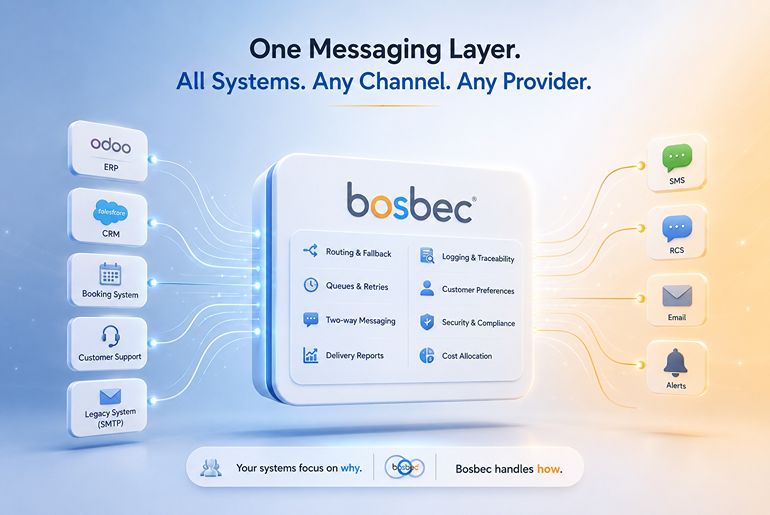
One messaging layer. All your systems. Any channel. Any provider.
Large organisations send millions of messages from many different systems.
SMS. RCS. Email.
Customer notifications, appointment reminders, one-time passwords, service messages, campaigns, employee communication and alerts.
The problem isn’t sending messages. It’s everything around them.
Messaging becomes fragmented surprisingly quickly
One legacy system sends SMS through email-to-SMS. Another sends SMS through an HTTP API. An ERP sends email over SMTP. A newer application uses an email API. Customer service needs two-way messaging. Another application wants RCS with SMS fallback.
Then the organisation also needs to handle delivery reports, replies, queues, retries, sender identities, provider credentials, logging, reporting and internal cost allocation.
None of this is unusual in a large organisation.
The problem is that every application gradually becomes responsible for part of the messaging infrastructure.
Change provider, introduce a new channel or change a security requirement and a commercial decision can quickly become an IT project.
Move the complexity into one messaging layer
Instead of building messaging infrastructure into every application, let the applications communicate through Bosbec.
Legacy systems → Email / SMTP → Bosbec
CRM / ERP / Booking / Support → API → Bosbec
Other applications → Existing interface → Bosbec
Bosbec can then handle what happens around the message:
- SMS, RCS and email
- Provider routing and fallback
- Queues, retries and rate handling
- Two-way messaging and replies
- Delivery reports and message status
- Logging and traceability
- Reporting and cost allocation
- Customer preferences, opt-out and communication rules
- Security, access and data handling
Your systems focus on why a message needs to be sent. Bosbec handles how the communication happens – and everything around it.
Change provider without changing every business system
Once your systems use a common messaging layer, the provider underneath can change without forcing the same change into every connected application.
Start with an aggregator.
If another provider offers better pricing or coverage, change the route behind Bosbec.
At sufficient volumes, you may decide to connect directly to operators.
Your systems → Bosbec → Aggregator
can evolve into:
Your systems → Bosbec → Multiple providers / Direct operators
The business applications can continue using the same interface.
That gives the organisation real commercial freedom and a much stronger position when negotiating messaging traffic.
Email without separate email infrastructure in every application
The same principle applies to email.
An application should not necessarily need its own mail server, SMTP configuration or email provider integration simply because it needs to send a confirmation or notification.
The application can send the request to Bosbec and let the common messaging layer handle the delivery.
Provider settings and messaging configuration can be managed centrally instead of being spread across many applications.
Introduce RCS without rebuilding the applications
A business may want to move some communication from SMS to richer RCS messages with images, buttons and interactive experiences.
That should not require rebuilding every system that initiates customer communication.
Today: System → Bosbec → SMS
Tomorrow: System → Bosbec → RCS
Or: System → Bosbec → RCS if available → SMS fallback
The communication channel can evolve while the originating business system remains unchanged.
Control the customer experience across systems
Centralising messaging also solves another problem: different business systems do not necessarily know what the other systems are sending.
The CRM sends a campaign. The booking system sends a reminder. The e-commerce platform sends an offer. Customer service sends an SMS.
Each message may make sense on its own. Together, they may be too much.
With Bosbec as the common layer, you can build rules around the customer rather than around each individual application.
- Limit how many non-critical messages a customer receives during a defined period.
- Separate transactional, service, marketing and alert messages and apply different rules to each category.
- Delay or suppress similar messages triggered by different systems.
- Prioritise an important appointment reminder over a marketing campaign.
- Use customer channel preferences to decide between email, SMS or RCS.
- Handle opt-out as a separate central process and make the result available to future communication.
- Prevent duplicate messages when two systems trigger essentially the same communication.
- Use fallback rules when a preferred channel or provider is unavailable.
Imagine three systems decide to contact the same customer on the same morning. The booking reminder can be prioritised, the offer delayed and the reactivation campaign suppressed.
Each business system still does its job – but the customer experiences one coordinated organisation.
One place for reporting and internal cost allocation
When messaging is distributed across providers and applications, reporting becomes fragmented too.
With a common messaging layer, you can build the reporting your organisation needs:
- Traffic by system, business unit, country or channel
- SMS, RCS and email volumes
- Delivery rates and failures
- Provider performance
- Cost by department, cost centre, application or customer process
- Internal invoicing or chargeback between business units
- Responses and two-way messaging activity
Instead of accepting the reporting model of each provider, you can build a common view around the way your organisation actually works.
Build security and compliance into the messaging architecture
Messaging is also a security, data governance and compliance question.
When every application has its own messaging integration, provider credentials, API keys, customer data, message content, logs and configuration can become distributed across many systems and suppliers.
That makes important questions harder to answer:
- Which providers receive our data?
- Where is information processed and stored?
- Who has access to provider credentials and configuration?
- What is logged and how long is it retained?
- Which systems depend on which external messaging services?
- What happens if a provider becomes unavailable?
With Bosbec as a common messaging layer, more of this control can be centralised. Provider connections, routing, logging, data handling and operational rules can be managed through a common architecture.
This can support organisations working with security frameworks and regulatory requirements such as GDPR, ISO/IEC 27001 and, where applicable, DORA by making messaging flows, dependencies, access and operational controls easier to structure, document and audit.
Bosbec does not replace an organisation’s compliance framework. It provides a place where the messaging architecture can be implemented and controlled according to it.
What could that be worth?
For large messaging volumes, even small differences in unit price become significant.
If an organisation sends 20 million SMS messages per year, reducing the average cost by:
€0.005 per message saves €100,000 per year.
€0.01 per message saves €200,000 per year.
€0.02 per message saves €400,000 per year.
But traffic cost is only one part of the business case.
There is also the cost of maintaining multiple integrations, changing applications when suppliers change, managing separate email infrastructure, consolidating delivery reports, handling provider credentials, producing internal reporting and allocating costs.
And there is the value of being able to negotiate.
If changing supplier means rebuilding ten integrations, you are not truly supplier-independent. If it means changing the routing behind Bosbec, the commercial conversation is very different.
Why build this in Bosbec?
You could build your own central messaging platform.
Create the APIs. Support SMTP and legacy interfaces. Build SMS and RCS integrations. Handle email. Add routing, queues, retries, delivery reports, replies, opt-out, customer rules, logging, reporting, cost allocation and security controls. Then operate and maintain it.
But now your messaging problem has become another internal software platform someone has to own.
Or you can let every application choose its own messaging solution and accept the fragmentation and dependencies that follow.
Bosbec gives you another option.
One place to connect your systems, configure your messaging, build your rules, control your providers and follow what happens – while keeping the freedom to change the infrastructure underneath.
Start simple. Keep your options open.
You don’t have to transform the entire organisation at once.
Start with one system and one channel.
Connect it to Bosbec.
Then move the next system.
Add SMS. Add email. Add RCS. Add two-way communication. Add routing and fallback. Add customer rules. Build the reporting and cost allocation you need.
Over time, the messaging infrastructure can evolve without forcing every connected business system to evolve with it.
Your systems shouldn’t care whether a message is delivered by SMS, RCS or email – or which provider delivers it.
They should simply tell Bosbec what needs to happen.
How to get started in Bosbec
A practical starting point is to create a common interface into Bosbec for the systems that need to send messages. Existing systems can continue using interfaces that fit them, while Bosbec workflows handle processing, routing and communication with external services.
From there, add the rules and capabilities your organisation needs: providers, channels, delivery handling, reporting, customer communication policies and security controls.
Start with one integration. Build the messaging layer your organisation needs.
Test to build a messaging service here