Creating an event is easy. Managing everything around it often is not.
The event itself may only last an hour, but organising it can involve creating an invitation, collecting registrations, monitoring capacity, sending confirmations and reminders, recording attendance and following up afterwards.
Many companies try to manage this through a combination of their CRM system, spreadsheets, forms, email tools and manual lists. The CRM may contain the contacts, but turning those contacts into a complete event process often requires significant configuration and hands-on work.
This is a good example of a digital service that should be simple to start with—and easy to extend when the need grows.
The problem is not creating the event
Most organisations already have tools for calendars, email and customer data. The difficulty is making the entire process work together.
Someone creates an event page. Registrations arrive through a form. Participant details are copied into a spreadsheet or CRM. Confirmation emails are sent from another system. A separate list is used at the entrance, and after the event, someone tries to determine who attended and who should receive a follow-up message.
Each individual step is manageable. The manual work appears between the steps.
Common challenges include:
– keeping track of the number of available places;
– closing registration when the event is full;
– knowing who has registered, cancelled or attended;
– sending the correct confirmation and reminder messages;
– avoiding duplicate registrations;
– keeping contact information updated across systems;
– following up with attendees and non-attendees differently;
– collecting and compiling feedback after the event.
For a single small event, a spreadsheet may be enough. For recurring customer events, training sessions, seminars, product demonstrations or internal activities, the process quickly becomes difficult to manage.
Start with the simplest useful service
The first version does not need to be a complete event-management platform. It only needs to solve the central problem well.
An organiser creates an event and enters:
– the event name;
– date and time;
– location or meeting link;
– the number of available places;
– a short description and practical information;
– the information participants must provide when registering.
Bosbec then creates a public registration page with a unique link. The organiser can share that link through email, social media, a website, a QR code or any existing communication channel.
Visitors open the page and register using their name and email address, with the option to provide a mobile number or other relevant information. The registration is stored directly in Bosbec, the remaining capacity is updated and the participant receives a confirmation.
That alone replaces several manual steps with one connected process.
One event, one link and one participant list
The organiser should not have to build a new form, spreadsheet and communication flow for every event.
With a reusable Bosbec template, the process can be straightforward:
- Create the event.
- Add the time, capacity and event information.
- Publish the registration page.
- Share the generated link.
- Follow registrations in a single interface.
The service can automatically prevent new registrations when all places have been taken. It can also support a waiting list, allow participants to cancel through a personal link and make a place available to the next person.
The organiser gets a current participant list without maintaining a separate spreadsheet. Because the data is already structured in Bosbec, it can immediately be used in workflows and connected to other systems.
Add invitations when they are needed
For some events, sharing a public link is enough. For others, the organiser already knows who should be invited.
The same template can therefore be extended with an invitation function. Contacts can be selected from data stored in Bosbec, imported from a file or retrieved from a CRM system. The organiser writes the invitation, selects the recipients and sends it by email or SMS.
Each invitation can contain the event information and a registration link. Where appropriate, the link can be personal, making it possible to see who has opened, accepted or declined the invitation without asking them to enter information the organisation already has.
This creates a connected journey:
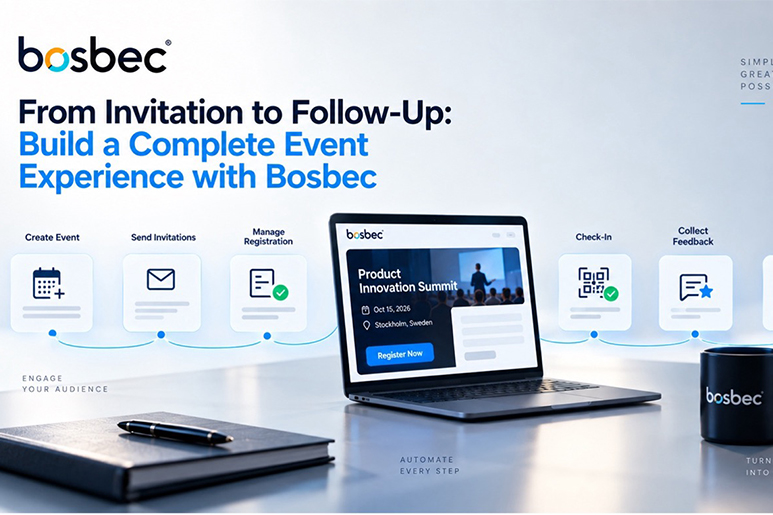
Invitation → Registration → Confirmation → Reminder → Attendance → Follow-up
Instead of configuring each step separately in a conventional CRM system, the entire journey can be included in the Bosbec template and adapted to the organisation’s needs.
Know who actually attended
A registration list shows who intended to attend. It does not show who was actually there.
The service can therefore include a simple check-in interface. At the event, the organiser can search for a participant and mark them as present. Participants could also check in themselves using a QR code or personal link.
Attendance becomes structured data rather than a handwritten note or an updated spreadsheet. This makes the follow-up more relevant:
– attendees receive presentation material and a thank-you message;
– people who registered but did not attend receive a recording or information about the next event;
– cancelled participants can be invited to a future session;
– sales or customer teams can receive follow-up tasks for selected participants.
If a CRM system is used, Bosbec can update the contact record with the invitation, registration and attendance history. The CRM remains the customer system, while Bosbec manages the event process around it.
Continue the conversation after the event
The event should not end when the participants leave.
A follow-up workflow can automatically send an evaluation by email or SMS. The form can ask participants to rate the event, comment on the content and indicate whether they want more information.
The answers can be stored together with the event and participant data, making it possible to see:
– the overall satisfaction score;
– which sessions or topics were most valuable;
– recurring comments and improvement suggestions;
– which participants want to be contacted;
– how results compare across several events.
Bosbec can also use AI to summarise free-text feedback, identify common themes and prepare a concise report for the organiser. The original answers remain available, so every conclusion can be traced back to the underlying data.
A template that grows with the use case
The value of the Bosbec template is not that every organisation must use every function from day one. The value is that the basic service works immediately and can be expanded without rebuilding the entire process.
The first version may contain only:
– event creation;
– capacity management;
– a public registration page;
– participant registration;
– confirmation messages;
– a participant list.
The organisation can then add the capabilities it needs:
– email and SMS invitations;
– personalised registration links;
– automatic reminders;
– waiting lists and cancellation handling;
– QR-code check-in;
– CRM integration;
– calendar invitations;
– follow-up tasks;
– evaluations and feedback analysis;
– dashboards for registrations, attendance and results.
The interface, fields, rules and communication can all be adapted to the specific event type. A customer seminar may require company and job title. A training session may require course selection. An internal event may already know the participant’s identity. A private celebration may need only a name, email address and a short message to the host.
More than a registration form
A form collects answers. An event service manages a process.
That distinction matters. The real value is not simply having a page where people can register. It is knowing what should happen when someone registers, when the event becomes full, when a participant cancels, when a reminder should be sent and when the organiser needs to follow up.
Bosbec brings the data, interfaces, communication and workflows together in one solution. It can work as a standalone service or connect to the CRM, email platform and other systems the organisation already uses.
The result is a service that is simple enough to use for the first event, but structured enough to support hundreds of events and increasingly advanced customer journeys.
Start by creating the event and sharing the link. Add invitations, attendance and evaluations when they create value. The process grows with the need—without bringing back the manual work it was designed to remove.