Customers have more ways than ever to interact with a business.
Apps. Websites. Email. Chat. SMS.
But sometimes they still want to pick up the phone and call.
For many businesses, that’s a problem.
Someone has to answer. Calls arrive at the same time. Customers end up waiting in queues. And employees spend time handling simple, repetitive requests that could have been resolved automatically.
The answer isn’t to make customers stop calling.
It’s to make the phone channel work better.
Let customers get things done while they’re on the phone
Imagine a medical clinic.
A patient calls and says:
“I’d like to book an appointment next Tuesday afternoon.”
Instead of waiting for a receptionist, a voice bot can understand the request, check available appointments in the booking system and offer suitable times.
The patient chooses a time.
The appointment is booked.
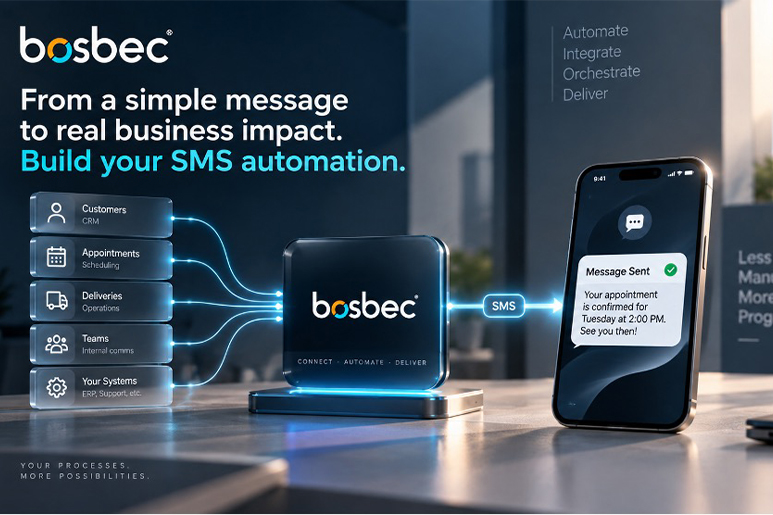
A confirmation is sent by SMS.
And the booking is stored in the same system the clinic already uses.
The entire process can happen during one conversation.
Voice can become part of your business process
Booking a medical appointment is just one example.
The same idea could be used by a tyre shop:
“I need to change to winter tyres next week.”
The voice bot can ask for the registration number, find the right service, check available appointments and make the booking.
Or in customer support:
“What’s happening with my support case?”
Identify the customer, retrieve the case from the support system and give the caller an update.
If the issue needs a person, transfer the call – together with the information already collected.
The goal isn’t to automate every conversation.
It’s to automate the parts that don’t need to be manual.
Don’t build another isolated voice bot
This is where voice automation becomes really useful.
A voice bot that can only answer questions isn’t necessarily solving the business problem.
It needs to be able to do things.
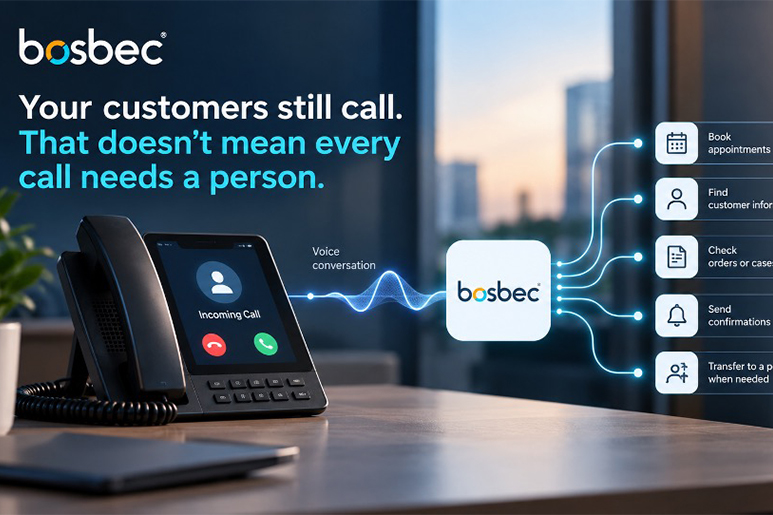
Check a calendar. Create a booking. Find a customer. Read an order. Look up a support case. Update a CRM. Send a confirmation. Transfer the caller to the right person when needed.
That’s why the voice bot should be part of the same business processes as your other channels.
Call → Understand → Get data → Take action → Update systems → Confirm
Why build this in Bosbec?
You can buy voice bots and AI assistants.
But the interesting part is rarely the conversation itself.
The difficult part is connecting the conversation to your systems, your data and the actions the customer actually wants to perform.
And every business is different.
A medical clinic needs its booking rules.
A tyre shop needs vehicle information, services and available workshop times.
A support organisation needs customer identification, case information and escalation rules.
With Bosbec, you build the process around the way your business actually works.
Start with the voice channel and then connect the booking system, CRM, support platform, ERP or whatever else the conversation needs.
Bosbec handles the process around the call while the telephony platform handles the call itself.
Keep the phone channel – remove the unnecessary work
Voice automation isn’t about replacing customer service.
It’s about making sure a customer doesn’t have to wait for a person to perform something that could have happened immediately.
That can mean shorter queues, service outside normal opening hours and less repetitive work for employees.
But perhaps most importantly, it means you can continue offering the channel many customers still prefer – without every additional call creating additional manual work.
Build it with Bosbec and Vonage
One way to build this is with Bosbec and Vonage Voice API.
Vonage provides the programmable voice layer. Its Voice API supports inbound and outbound calls, speech input, text-to-speech, recording and voice bots. For real-time AI voice applications, Vonage can also stream call audio bidirectionally over WebSockets to an application.
Bosbec can then provide the business process around the conversation:
Vonage → Voice conversation → Bosbec → Your systems → Action → Response
Start with a simple use case.
Connect a Vonage number.
Let the caller describe what they want.
Use Bosbec to connect the conversation to the systems and data required to complete the task.
Then build from there.
Add booking. Add customer identification. Add confirmations. Add CRM logging. Add escalation to a person.
Start with one call your employees handle every day. Build a better way to handle it.