Public AI services have quickly become a natural tool in many organizations. They are powerful, fast, and capable of creating value in everything from content generation to analysis.
But they also have a clear limitation: they fundamentally operate on public or generic information.
The real business value only emerges when AI can work with your own operational data—customer relationships, sales, costs, forecasts, and operational patterns.
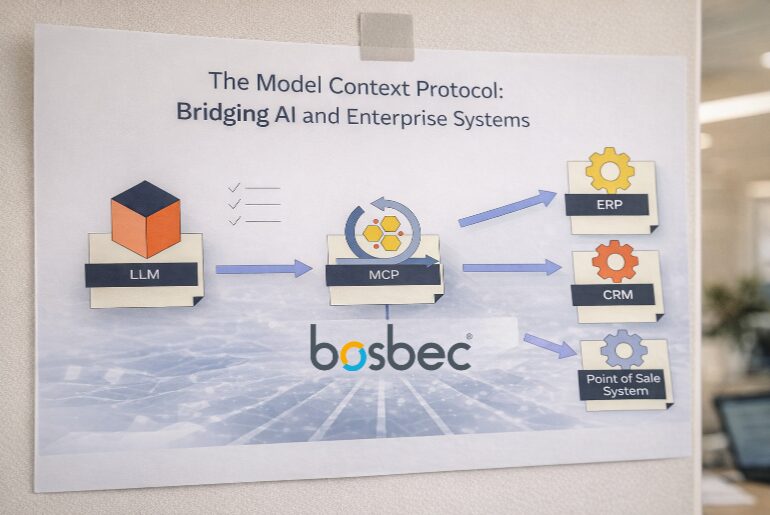
This is where MCP (Model Context Protocol) and integration platforms like Bosbec change the game.
The Problem: AI Without Business Context
When AI lacks direct access to internal systems, the results are often:
- Generic instead of actionable
- Based on assumptions rather than facts
- Limited by the model’s memory and context window
For AI to become a true strategic decision support system, a way is needed to:
- Retrieve the right data—securely and in a controlled manner
- Compile it so the AI can understand it without exhausting memory
- Protect sensitive information while still enabling analysis
This is exactly what MCP, combined with Bosbec, enables.
MCP: The Bridge Between AI and Your Real Data
With MCP, you can make selected business data available to AI in a structured and controlled way.
Instead of sending massive datasets directly to the model:
- Information is filtered and summarized
- Structured for analysis
- Delivered only when the AI actually needs it
The result is that AI can:
- Reason using up-to-date business data
- Create forecasts based on real numbers
- Provide recommendations that are truly actionable
Bosbec: Where Integration, Security, and Intelligence Meet
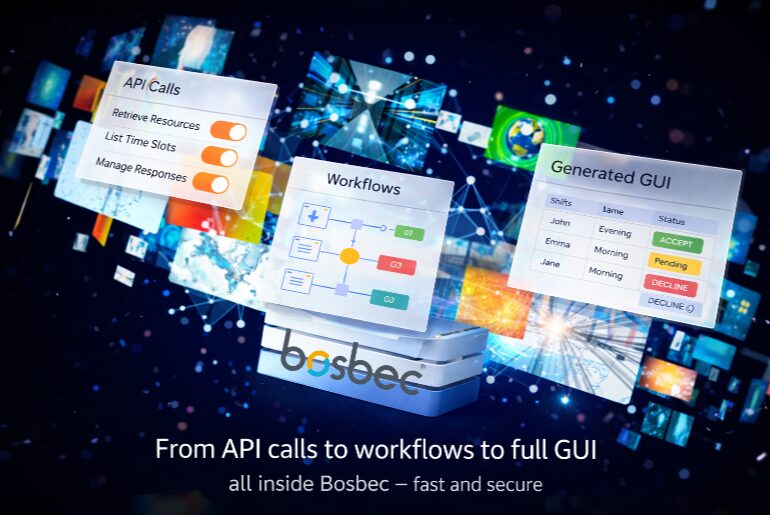
Bosbec simplifies the entire journey from raw data to AI-driven insight.
1. Integration First
In Bosbec, you connect your systems—for example:
- ERP
- Point-of-sale systems
- E-commerce platforms
- CRM
The platform manages data collection, synchronization, and structuring.
2. AI-Ready Data Compilation
Instead of letting AI read raw databases:
- Bosbec aggregates data
- Creates analysis-friendly views
- Optimizes information volume for the AI model’s memory
This allows AI to operate faster, more cost-efficiently, and with greater precision.
3. Secure De-Anonymization
In many cases, AI must analyze sensitive information—without exposing it.
Bosbec makes it possible to:
- Encrypt or anonymize data before sending it to AI
- Decrypt specific information only when needed
- Maintain full control over what the model actually sees
This creates a balance between privacy, security, and business value.
A Practical Scenario: From Sales to Forecast
Imagine an organization where:
- ERP, point-of-sale, and e-commerce are already integrated through Bosbec
- An MCP is created for sales teams and leadership
Within a single AI conversation, you could then:
- Analyze customer segments and purchasing behavior
- Identify profitable products and risk areas
- Build next year’s sales forecast
- Receive concrete activity recommendations
- View detailed cost and revenue plans
All of this—in the same dialogue.
This is where AI evolves from being a tool into a digital business partner.
The Next Step: AI as Operational Decision Support
When MCP and Bosbec are combined, something bigger than integration emerges:
- AI gains true business understanding
- Decisions can be made data-driven in real time
- Forecasts become dynamic instead of static
The future is therefore not about more AI—
but about the right data, in the right form, at the right time.
And here, MCP together with Bosbec becomes a key component in how modern organizations build business-native intelligence.
In short:
Public AI provides answers.
Business-connected AI delivers results.