There are many powerful automation tools available today, and n8n is one of the most popular ones. It’s flexible, open, and relatively easy to get started with. At the same time, there are platforms like Bosbec that are built with a very different focus: long-lived systems, data models, and business-critical logic.
The question is not whether n8n is good.
The real question is whether it is the right tool when what you’re building actually matters to the business.
To explore this, I tried to recreate a solution already built in Bosbec using n8n instead. Not a toy example, but a real scenario resembling a production system.
The case involved:
- Weekly imports of multiple CSV files
- Tens of thousands of records
- Data transformation and persistence
- API access for a web interface
- Dynamic content driven by stored data
In other words: a fairly typical business system.
First impressions: n8n is fast and capable
The first thing that stands out is how quickly you can get started with n8n.
Setting up scheduled workflows, fetching files, running parallel jobs and transforming data is straightforward. The tooling feels modern and flexible, and for integration work it’s very efficient.
For automation and data movement, n8n does an excellent job.
But once you move beyond automation and start treating it as a platform rather than a tool, some limitations become clear.
When real-world data hits a strict system
One of the first friction points was CSV handling.
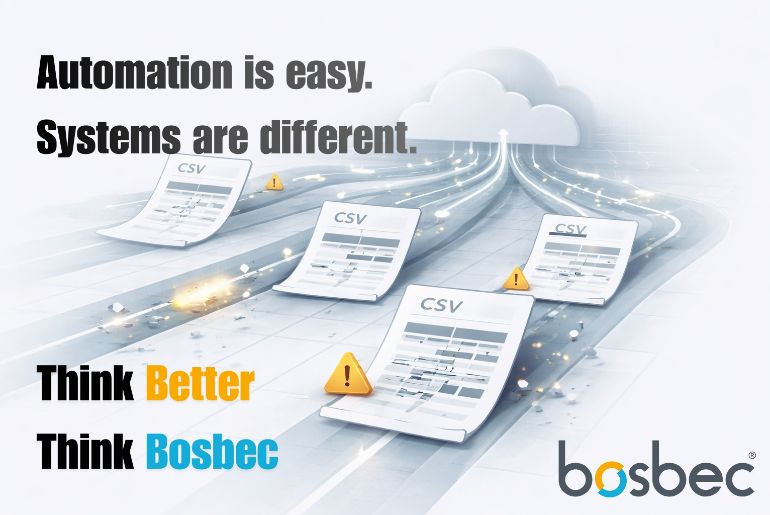
The same CSV files worked without issues in Bosbec, but failed in n8n. The reason was simple: the files weren’t perfectly compliant with the CSV standard. This is common in the real world, where data is often messy, inconsistent, or produced by systems you don’t control.
In n8n, this meant errors and manual intervention. The only solution was to add custom code to clean or rewrite the data before it could be processed.
This highlights an important difference in philosophy:
Bosbec is built to handle imperfect real-world data.
n8n assumes well-formed input.
Neither approach is wrong, but they serve very different use cases.
When automation starts to look like an application
The next step was to see how far n8n could be pushed.
Could it act as a backend?
Could it serve web content?
Could users interact with it dynamically?
Technically, yes.
Practically, this is where things start to break down.
Every request to a webhook is a workflow execution. Every page load, every click, every data fetch becomes a new run. That means:
- higher cost
- more complexity
- harder predictability
- less control over performance
At this point, n8n stops behaving like a backend and starts feeling like a workaround.
It becomes clear that n8n is optimized for short-lived, event-driven tasks — not for long-running systems with persistent state and user interaction.
The architectural difference that really matters
This is where the real distinction becomes obvious.
n8n is designed for:
- automation
- integrations
- event-driven workflows
- short execution lifecycles
Bosbec is designed for:
- data models
- persistent state
- business logic
- simulations
- long-running systems
- tolerance for imperfect data
Trying to use n8n as a core application platform is a bit like using a task scheduler as a database. It can be done, but it’s not what the tool was built for.
Can n8n be used for business-critical systems?
Technically: yes.
Practically: rarely a good idea.
Long-term: risky.
The issue isn’t performance.
It’s predictability, cost control, and maintainability.
Business-critical systems require:
- stable data models
- controlled execution
- predictable costs
- tolerance for edge cases
- long-term maintainability
These are not n8n’s strengths. They are Bosbec’s.
Final thoughts
After building and testing both approaches, the conclusion is fairly clear:
n8n is an excellent automation and integration tool.
But it is not a good foundation for business-critical systems.
Bosbec, on the other hand, is designed for exactly that: systems that live for years, not minutes; systems where data matters more than workflows.
The most important insight from this exercise is simple:
You don’t really understand a platform until you try to build something that actually matters on top of it.
n8n and Bosbec are not competitors.
They complement each other.
And when used that way, both shine.